
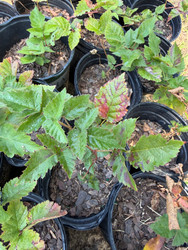
Why Are My Caddo Blackberry Leaves Turning Red or Purple?
Aug 26th 2026
Seeing red or purple areas on the leaves of a young Caddo blackberry plant can be concerning. Fortunately, this coloration is often stress pigmentation—known as anthocyanin production—not an active disease.
Anthocyanins are natural plant pigments responsible for red, purple and blue coloring in leaves, flowers and fruit. Blackberry plants may produce more of these pigments when environmental conditions temporarily interfere with normal growth. Think of it as the plant’s protective response to stress rather than evidence that the plant is infected.
Why does stress pigmentation develop?
Young Caddo blackberry plants growing in containers are especially sensitive because their roots have a limited amount of soil surrounding them. Several conditions may cause their leaves to develop reddish-purple patches:
- Sudden exposure to intense sunlight
- Cool nights or rapid temperature changes
- Shipping, transplanting or moving the plant
- Potting mix that remains too wet
- Roots becoming crowded in the container
- Temporary difficulty absorbing phosphorus or other nutrients
Phosphorus may already be present in the potting mix, but cool, saturated or stressed roots may not be able to absorb it efficiently. For that reason, reddish leaves do not automatically mean the plant needs fertilizer. Applying extra fertilizer without identifying the cause can injure the roots and make the problem worse.
What are we doing to help?
At BerryKing, we are giving these young plants a light application of liquid kelp according to the product’s label directions. Liquid kelp is not a cure for disease or a replacement for proper nutrition, but it can be used as a gentle plant supplement during periods of environmental or transplant stress.
The most important care still comes from providing consistent moisture, good drainage and appropriate sunlight. We keep the potting mix evenly moist without allowing the containers to remain waterlogged. Plants that were recently shipped or moved from a protected growing area should also be introduced gradually to full sun.
Healthy new growth is the best indicator of recovery. Existing red areas may not turn green again, but new leaves should emerge green as the roots establish and growing conditions improve.
Stress pigmentation usually appears as broad red or purple coloring along the leaf edges, between veins or across larger portions of the leaf. It generally does not create sharply defined dead spots.
Watch for symptoms that could indicate a different problem, including round purple spots with tan or gray centers, orange powder underneath the leaves, raised pustules, distorted shoots or rapidly spreading leaf damage. These symptoms may point to fungal leaf spot, rust or another condition requiring closer attention.
In most cases, reddish-purple coloring on young Caddo blackberry leaves is temporary and does not threaten the plant. Consistent watering, good drainage, gradual sun exposure, a gentle liquid-kelp treatment and a little patience will usually help the plant settle in and resume healthy growth.
At BerryKing.com, we want growers to understand what their plants are communicating. A little temporary color is often simply part of a young blackberry plant adjusting to its new home.