
Blueberry Cross-Pollination Explained
Jan 28th 2026
Cross‑Pollination and Partner Plants: The Secret to Bigger, Sweeter Blueberries
Blueberries are one of the few fruit crops that truly reward growers who plan their plant pairings. Whether you’re growing Rabbiteye or Southern Highbush varieties, understanding cross‑pollination can dramatically improve yield, berry size, and flavor.
What Is Cross‑Pollination?
Cross‑pollination occurs when pollen from one blueberry variety fertilizes the flowers of another compatible variety. Bees and other pollinators carry pollen between bushes, and this exchange increases fruit set and berry quality.
Blueberries are self‑fertile, meaning a single plant can produce fruit—but cross‑pollination makes a big difference. Growers typically see:
-
25–50% higher yields
-
Larger berries
-
More uniform ripening
-
Better flavor and firmness
Rabbiteye Blueberries: Why They Need Partners
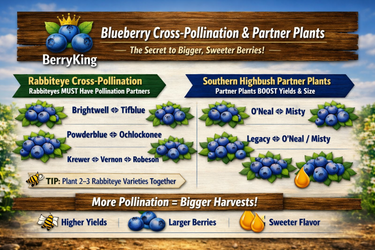
Rabbiteye blueberries (like Brightwell, Tifblue, Powderblue, Ochlockonee, Krewer, Vernon, Robeson, New Hanover, and Onslow) are native to the Southeast and thrive in warm climates. However, Rabbiteyes require cross‑pollination to produce full crops.
Best Practice
Plant at least two or three different Rabbiteye varieties that bloom at the same time. For example:
-
Brightwell ↔ Tifblue — excellent early‑mid pairing
-
Powderblue ↔ Ochlockonee — strong mid‑late pairing
-
Krewer ↔ Vernon ↔ Robeson — extended bloom overlap for consistent fruit set
This ensures bees can move freely between compatible flowers, maximizing pollination and yield.
Spacing Tip
Interplant varieties in alternating rows or mixed clusters rather than isolating each type. This encourages natural bee movement and even pollination across the block.
Southern Highbush Blueberries: The Benefit of Partner Plants
Southern Highbush varieties—like O’Neal, Misty, and Legacy—are partially self‑fertile, but they still benefit from having compatible partners nearby.
Why Partner Plants Help
Even though Southern Highbush can set fruit alone, cross‑pollination improves:
-
Berry size and sweetness
-
Seed development (which enhances flavor)
-
Overall plant vigor
Recommended Pairings
-
O’Neal ↔ Misty — early bloom overlap, excellent flavor synergy
-
Legacy ↔ O’Neal or Misty — mid‑season overlap for extended harvest
Planting these together ensures strong pollination and a steady harvest from early June through July.
Pollinators: The Unsung Heroes
Bees are essential for blueberry pollination. To attract and support them:
-
Avoid insecticides during bloom
-
Keep flowering cover crops nearby
-
Maintain moisture and mulch for healthy root zones
Healthy pollinator activity can double fruit set in Rabbiteye blocks.
BerryKing’s Proven Approach
At BerryKing, we design our plant groupings to maximize cross‑pollination and stagger ripening. Our mix of Southern Highbush (O’Neal, Misty, Legacy) and Rabbiteye (Brightwell, Tifblue, Powderblue, Ochlockonee, Krewer, Vernon, Robeson, New Hanover, Onslow) ensures:
-
Continuous bloom overlap
-
Strong bee movement
-
A harvest window from early June through August
✅ Key Takeaways
-
Rabbiteye blueberries must have cross‑pollination partners.
-
Southern Highbush blueberries benefit from partner plants for better fruit quality.
-
Bees are the bridge—keep them active and healthy.
-
Mixing compatible varieties ensures a longer, sweeter harvest season.
For more growing guides and variety details, visit ? BerryKing.com/blueberries